What the astronauts’ watches know about trust
I’m writing this at 32,000 feet.
A few hours ago at Sydney International, every eGate at passport control went down. Queues snaked back through the terminal. Flights were boarding. People were running for their gates.
Then something good happened. Within minutes, a team of humans opened the manual booths and stepped in. They picked up a process most travellers hadn’t seen in years and ran it superbly: calm, quick and human.
That was Plan B. It worked because someone had thought about it before it was needed.
Look closely at their wrists.
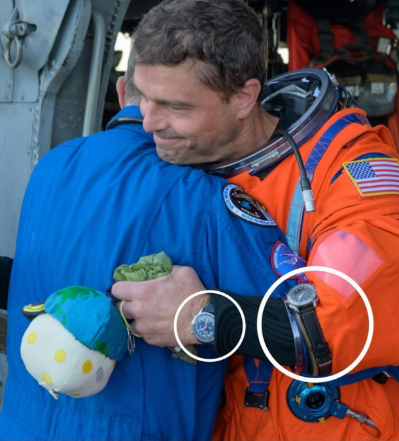
It reminded me of the Artemis II crew splashing down earlier this year. Look closely at their wrists, and you’ll notice something unusual. The astronauts are wearing more than one watch, and sometimes three.
This is not a coincidence.
The first is the Omega Speedmaster X-33, NASA’s standard-issue flight watch. On launch day, all four crew wore one secured to the outside of their suits.
The Speedmaster family has been NASA’s flight-qualified watch since 1965, and it earned that title the hard way: by surviving every test NASA could throw at it, from extreme heat and cold to vacuum, shock and vibration.
The second is a Breitling, the new Navitimer B02 Chronograph 41 Cosmonaute Artemis II. It is a nod to astronaut Scott Carpenter, who famously wore a Cosmonaute on 1962’s Mercury Atlas 7 mission, with a 24-hour dial so he could tell day from night in orbit.
Each watch had a job. One analogue-digital, one mechanical. One for precision, one for history. None trusted with everything.
In space, redundancy isn’t a luxury. It’s survival. You don’t rely on one system when the stakes are absolute, up there or, I’d argue, in business down here.
Every system needs a Plan B.
We live in a world of automation now. As much as we rely on technology to work, any system where people rely on each other needs a Plan B.
I’m seeing plenty of situations where the technology fails and Plan B hasn’t been thought through, or where the humans who should be Plan B simply aren’t there to carry it out.
This goes beyond business performance, leadership and customer service. It’s about keeping society running when the systems fail, rather than being at the mercy of the machines.
Not heroes. Plan B.
In a sales meeting recently, a client said something I haven’t stopped thinking about. She didn’t want her team to feel like saviours every time AI or the systems failed. She wanted them to embrace technology as an enabler.
I agree. We don’t need people beating their chests every time they save the day. That’s an imbalanced relationship with technology. The tech is there for a reason. But when the tech isn’t there, we must know how to keep the lights on. The show must go on, like the good old days.
Consistency in the standard. Humanity in the delivery.
Technology can hold the standard. Humanity is needed in the delivery.
Consistency doesn’t mean every conversation sounds the same. It means every customer can reliably expect ownership, clarity, timely acknowledgement, accurate information, respectful communication, and closure with follow-through. That should be true whether the system is running perfectly or has just gone dark.
So here’s the question to take to your team:
“What are the five things we want every customer to be able to rely on, regardless of the person, the system or the channel? And if the technology failed tomorrow, could our people still deliver them?”
When technology fails, the real test is whether your people can still deliver the moments that matter. Explore our Service Intelligence whitepaper to learn how to protect the human side of service in an AI-enabled world.